End-to-End Estimation
Monocular RGB video maps directly to robot motion without an explicit human-motion intermediate.
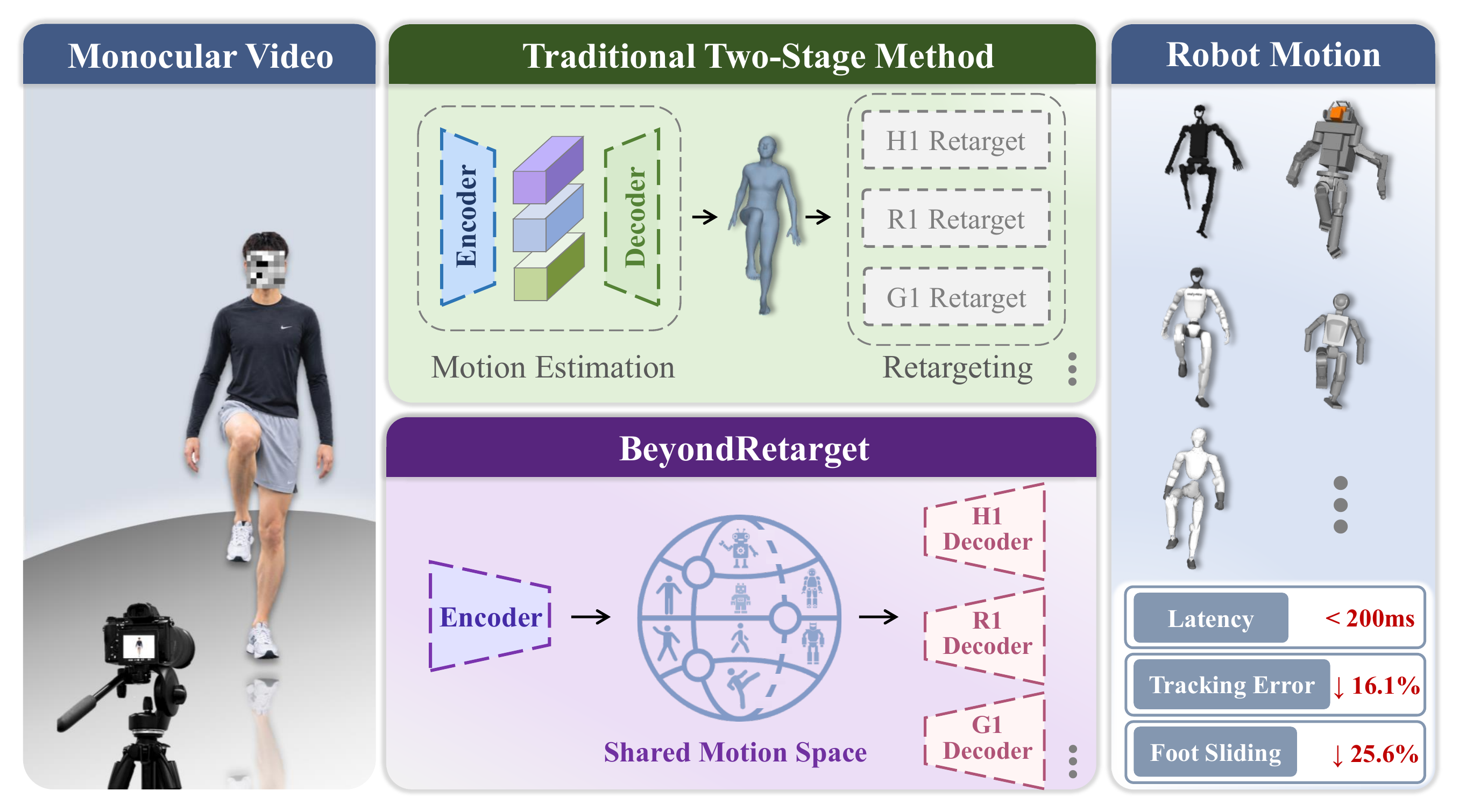
Beyond the conventional “human reconstruction → robot retargeting” pipeline.
TL;DR BeyondRetarget maps monocular RGB video directly to executable humanoid motions by learning robot-oriented implicit representations from visual observations, without an explicit human-motion intermediate.
Upload a monocular video of up to 10 seconds. BeyondRetarget will generate motion packages and a synchronized visualization for eight humanoid robots using Hugging Face community ZeroGPU resources.
Notice: All videos and the Interactive Online Demo on this project page use the base version of our method. This version meets the real-time requirements of teleoperation, but does not yet support moving-camera scenarios or large-scale global human trajectories. We plan to open-source a more general and higher-performance version later with support for freely moving cameras, stronger global trajectory capture, and improved generalization across diverse visual conditions, including indoor and outdoor environments.
Learning executable motions from human videos offers a scalable solution for humanoid robots to acquire demonstration motions. However, existing pipelines typically first construct an explicit human motion representation and then convert it into robot motions via motion retargeting. Although such methods can effectively leverage large volumes of existing human data for training, the substantial differences between humans and humanoid robots in locomotion mechanisms and joint degree-of-freedom configurations make motions generated by this human-representation-centric approach difficult to execute on robots. Furthermore, errors introduced during human motion estimation inevitably propagate to the retargeting stage and cannot be eliminated via joint optimization. We propose BeyondRetarget, an end-to-end framework that directly maps monocular RGB videos to robot motions. Discarding the explicit human representation, this framework learns robot-oriented implicit representations directly from visual observations, enabling the model to capture cross-morphology motion structures. To generate motions more suitable for robot execution, we further design a contact-aware motion optimization mechanism to improve temporal consistency and physical plausibility. Experiments show that BeyondRetarget significantly improves the accuracy and robustness of generated robot motions, while achieving higher execution success rates and lower latency in both simulation environments and real humanoid robots.
Monocular RGB video maps directly to robot motion without an explicit human-motion intermediate.
Implicit visual features capture motion structures across human and robot morphologies.
Contact-guided motion optimization improves temporal consistency and physical plausibility.
Simulation and real-robot tests show greater accuracy, robustness, execution success, and lower latency.
Conventional two-stage methods suffer from three fundamental limitations: an information bottleneck, because the retargeting stage cannot revisit the original visual evidence; error accumulation, because human-motion estimation and retargeting errors compound while the final robot-motion error cannot be propagated back for end-to-end optimization; and a robustness–adaptability trade-off. Optimization-based retargeting can support multiple robots, but its non-convex objective is prone to local optima and motion collapse. Learning-based retargeting can improve robustness, but adapting to a new robot requires a complete, high-quality robot-specific motion dataset and retraining the entire network from scratch.
BeyondRetarget replaces the disconnected two-stage pipeline with a shared motion encoder, robot-specific decoders, and a lightweight contact-aware refinement module. This unified design avoids the intermediate information bottleneck and cross-stage error accumulation while enabling efficient adaptation across robots, addressing the core limitations of two-stage methods.
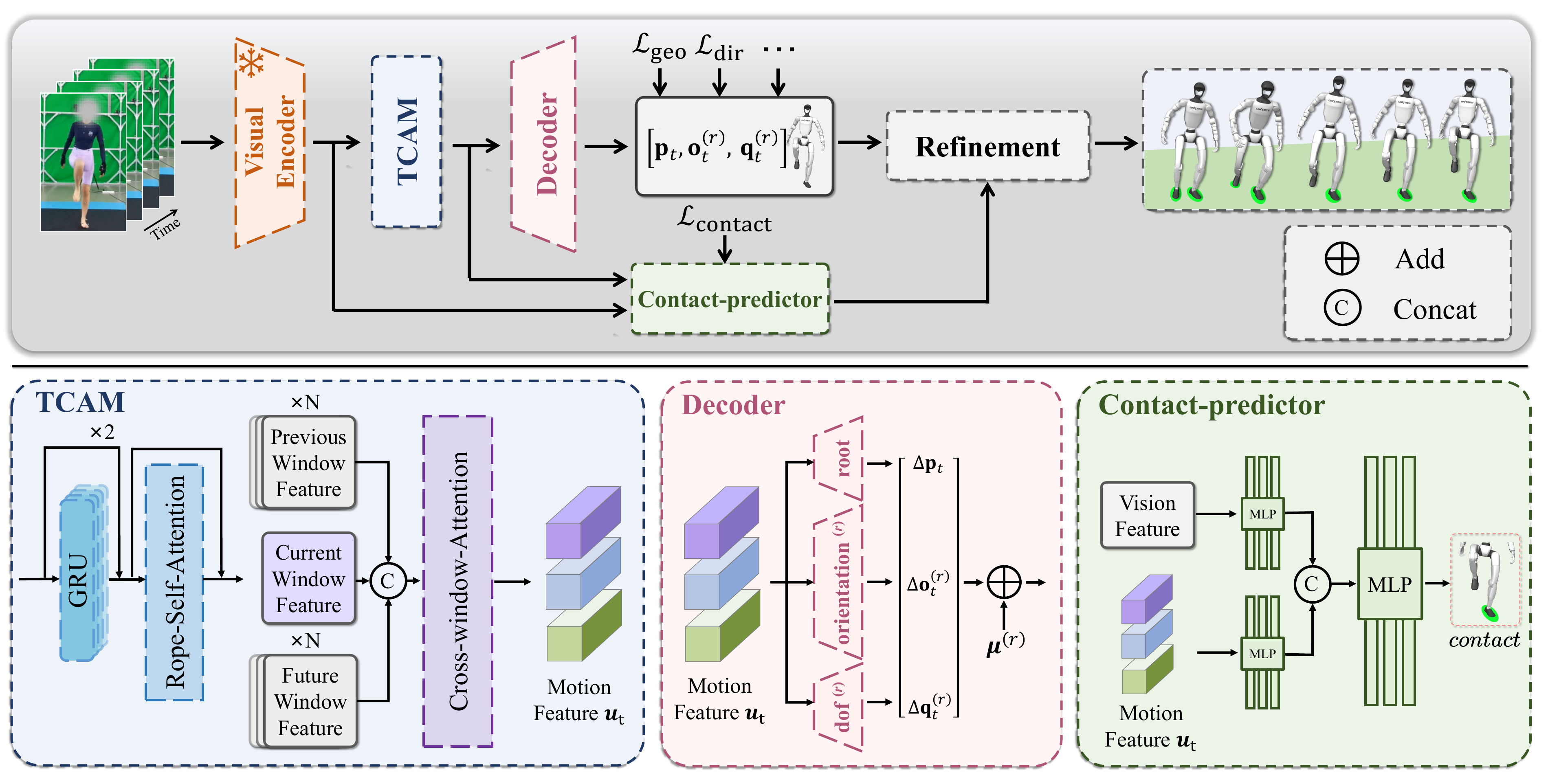
A frozen person detector and HMR2.0 visual backbone provide frame-level human-centric image features.
Bidirectional GRU encoding, RoPE self-attention, and cross-window attention model local and long-range motion context.
Residual output heads predict root trajectory, continuous root rotation, and robot-specific joint configurations.
Temporal filtering, root correction, and constrained leg IK improve physical consistency while retaining motion intent.
| Method | RAMPJPE ↓ | RTE ↓ | Jitter ↓ | Accel ↓ | Failure Rate (>65 mm) ↓ | Failure Rate (>100 mm) ↓ | Foot Slide ↓ | Simulation SR ↑ | Sim RAMPJPE ↓ |
|---|---|---|---|---|---|---|---|---|---|
| Ours | 26.36 | 80.74 | 1.41 | 1.51 | 0.00 | 0.00 | 1.71 | 95.86 | 35.04 |
| GVHMR → NMR | 39.19 | 701.13 | 1.63 | 1.56 | 6.21 | 2.22 | 2.28 | 93.92 | 43.32 |
| GVHMR → GMR | 39.46 | 637.33 | 7.94 | 2.51 | 3.43 | 0.28 | 3.30 | 86.46 | 41.77 |
| WHAM → NMR | 43.15 | 849.36 | 4.87 | 3.07 | 9.36 | 4.17 | 6.64 | 94.48 | 46.56 |
| WHAM → GMR | 45.88 | 217.76 | 63.26 | 14.57 | 10.47 | 6.30 | 13.30 | 81.49 | 42.89 |
| GT → NMR | 33.26 | 837.62 | 1.71 | 1.16 | 3.99 | 1.39 | 1.30 | 95.58 | 40.32 |
| GT → GMR | 32.02 | 36.01 | 10.65 | 2.27 | 0.00 | 0.00 | 0.82 | 95.86 | 35.93 |
RAMPJPE (mm) · lower is better
| Method | H1 | T1 | Tienkung | G1 | R1 | GR1‑T1 | GR2‑V3 | Atlas |
|---|---|---|---|---|---|---|---|---|
| Ours | 51.315 | 51.246 | 67.991 | 26.362 | 27.809 | 43.778 | 49.059 | 72.047 |
| GVHMR → GMR | 77.787 | 70.090 | 103.230 | 39.46 | — | — | — | — |
| WHAM → GMR | 99.663 | 77.261 | 115.858 | 45.88 | — | — | — | — |
“—” denotes robots unsupported by GMR.
| Method | Latency (ms) ↓ | Throughput (FPS) ↑ | Peak VRAM (GiB) ↓ |
|---|---|---|---|
| Ours | 192.8 | 50.02 | 7.03 |
| GVHMR → GMR | 1369.4 | 44.31 | 9.18 |
| GVHMR → NMR | 1305.7 | 44.36 | 9.73 |
On the same GPU, we build streaming inference pipelines for different methods and configure each to achieve the lowest possible latency, then measure their median latency and peak VRAM usage. We separately test their maximum throughput under the condition of unlimited input speed.
With BeyondRetarget, responsive real-time monocular visual teleoperation is possible.
The paper citation will be available after the public release.